The first stake pool on Cardano's Shelley mainnet.

Run by Marcus since the Jormungandr testnet in 2019. Redundant nodes, a 0.9 % variable fee, and every block it gets assigned is planned in advance.

Pool ID 153806dbcd134ddee69a8c5204e38ac80448f62342f8c23cfe4b7edf

Loading the block schedule…

Variable fee
0.9 %
Blocks minted since epoch 210
24,354
Average return, last 73 epochs
2.17 %
Active stake
55.1 M ₳

Pool journal

Node updates, milestones and maintenance notes, newest first.

2025

Midnight server ready

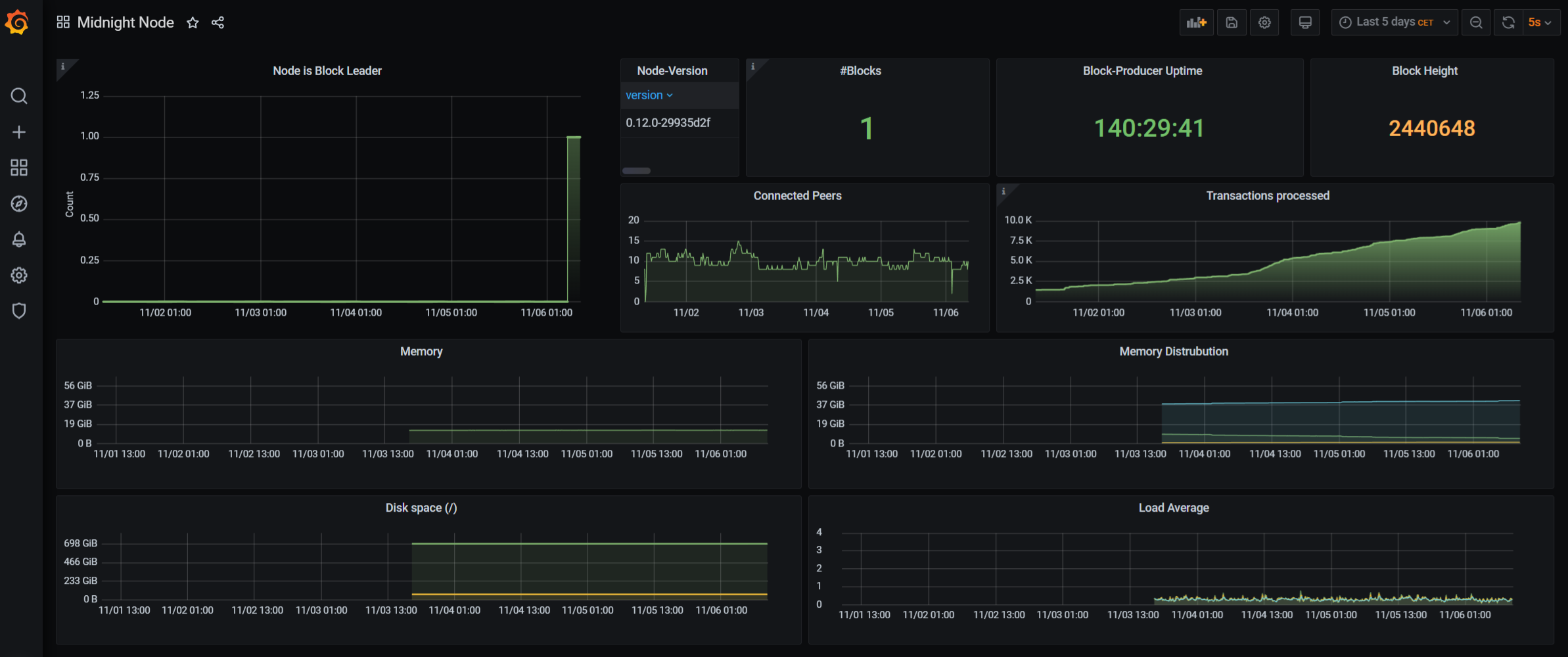
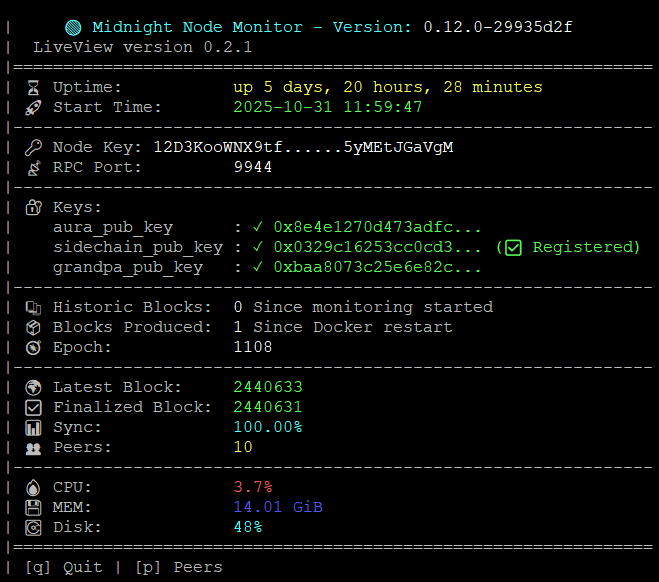
As most of you know, the Midnight network is progressing and will be live next year. I started to build up my Midnight server, which is tightly connected with the OCTAS Cardano pool. This means that soon you will also receive NIGHT tokens as epoch rewards next to the normal ADA rewards.

At least I'm ready for it and wait for the production release. The first block on Midnight testnet got mined last night 😊

2023

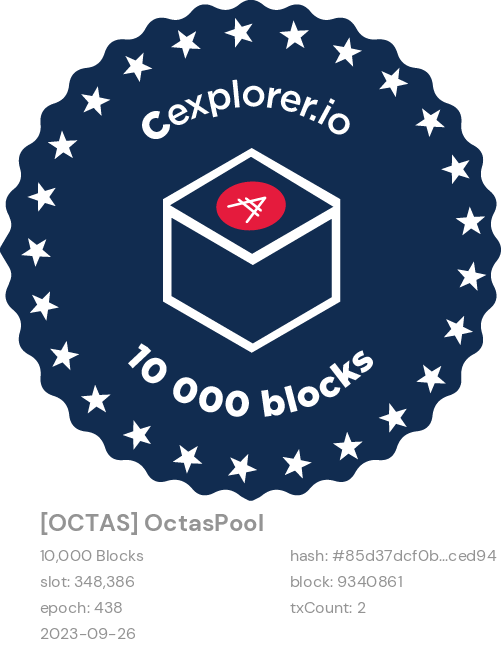
Big milestone reached: 10,000 blocks

Today we reached a new milestone 🥳 OCTAS is one of few pools which reached 10,000 blocks as a solo pool!

I'm really proud that everything is running smoothly for 3 years and very thankful that all of you joined me on my Cardano journey.

Love you all 😊
Marcus

2021

SundaeSwap community voting

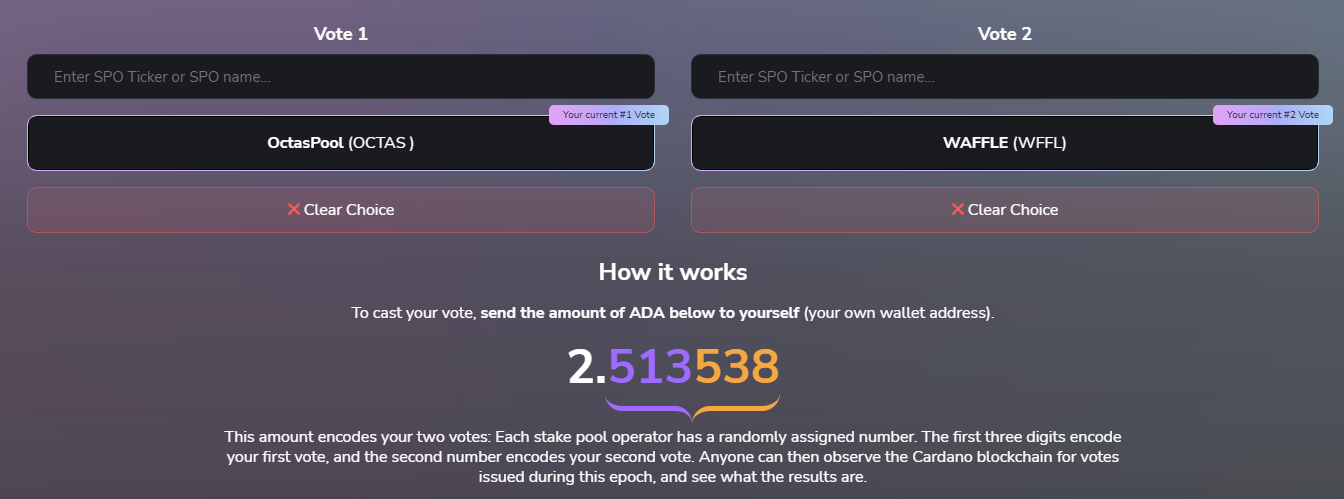
The SundaeSwap DEX, which will launch very soon, offers an ISO to all delegators of a pool. This is kind of an airdrop of tokens for free. To be part of the pools that receive the tokens, a pool has to be among the 30 most voted pools.

To vote for OCTAS you have to send exactly 2.513538 ₳ from your wallet to your own wallet address (so to yourself). This only costs you one transaction fee of 0.17 ₳. All transactions with these amounts will be counted as votes and identified after epoch 302 ended. Your voting power equals the amount of ADA you have in your wallet.

We vote for OCTAS and WFFL because we partnered with this pool to also receive the second vote from their delegators and increase the chance for both of our pools.

Voting is only possible until the end of epoch 302. More information: iso.sundaeswap.finance

Thanks for your support – let's do this together!

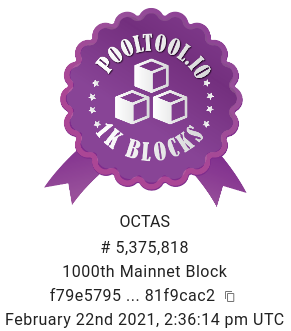
A new milestone: 1,000 blocks

We reached a new milestone: 1,000 blocks! It took about 5 months to reach this point.

OCTAS has a very solid standing and ensures good returns of ~5.5 % yield per year.

Thanks to all of YOU – this is only possible with you as loyal delegators ❤️

2020

New crystal ball for the running epoch

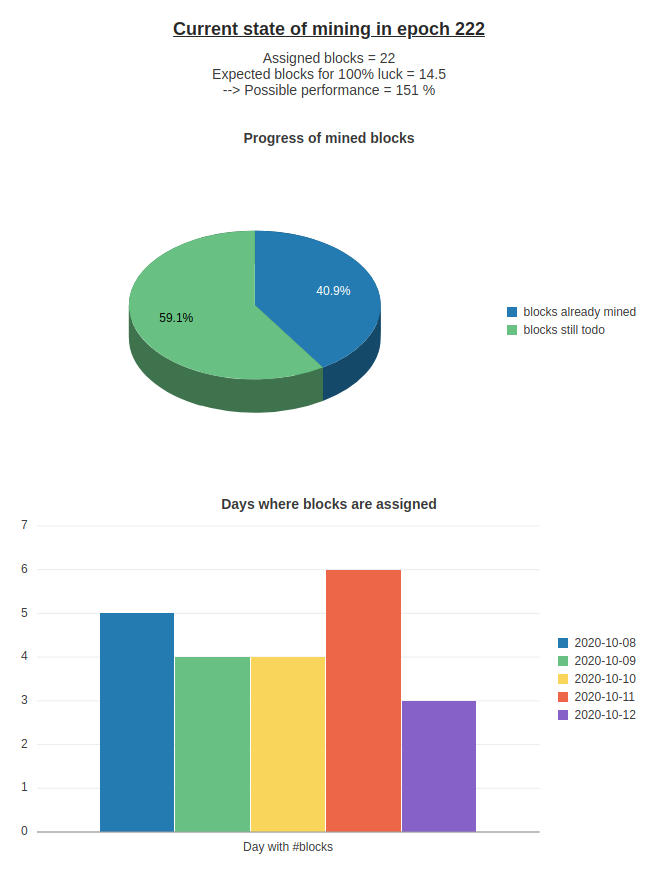
Because of the incredible work of Marcel Baumberg [TITAN], Andrew Westberg [BCSH] and Papacarp [LOVE] there is a new way to calculate the upcoming blocks for an epoch before they happen! This is only possible for the operator of each pool, but a very nice feature 😍

Based on this data I extended the rewards page with:

  • Number of assigned blocks for the running epoch
  • Number of blocks per day
  • Expected performance in comparison to the expected blocks

New performance page + celebrations 🥳

I added a new page to my website, “Performance”, where I try to explain how performance works in the Cardano protocol.

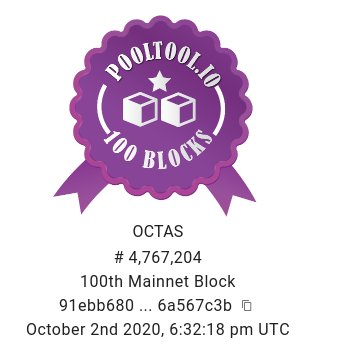
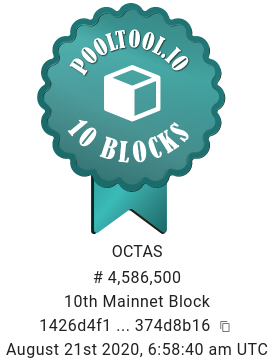
Next to this: today we reached the next big milestone of 100 blocks minted on mainnet 😍

Upcoming milestones ahead 😊

New rewards overview page

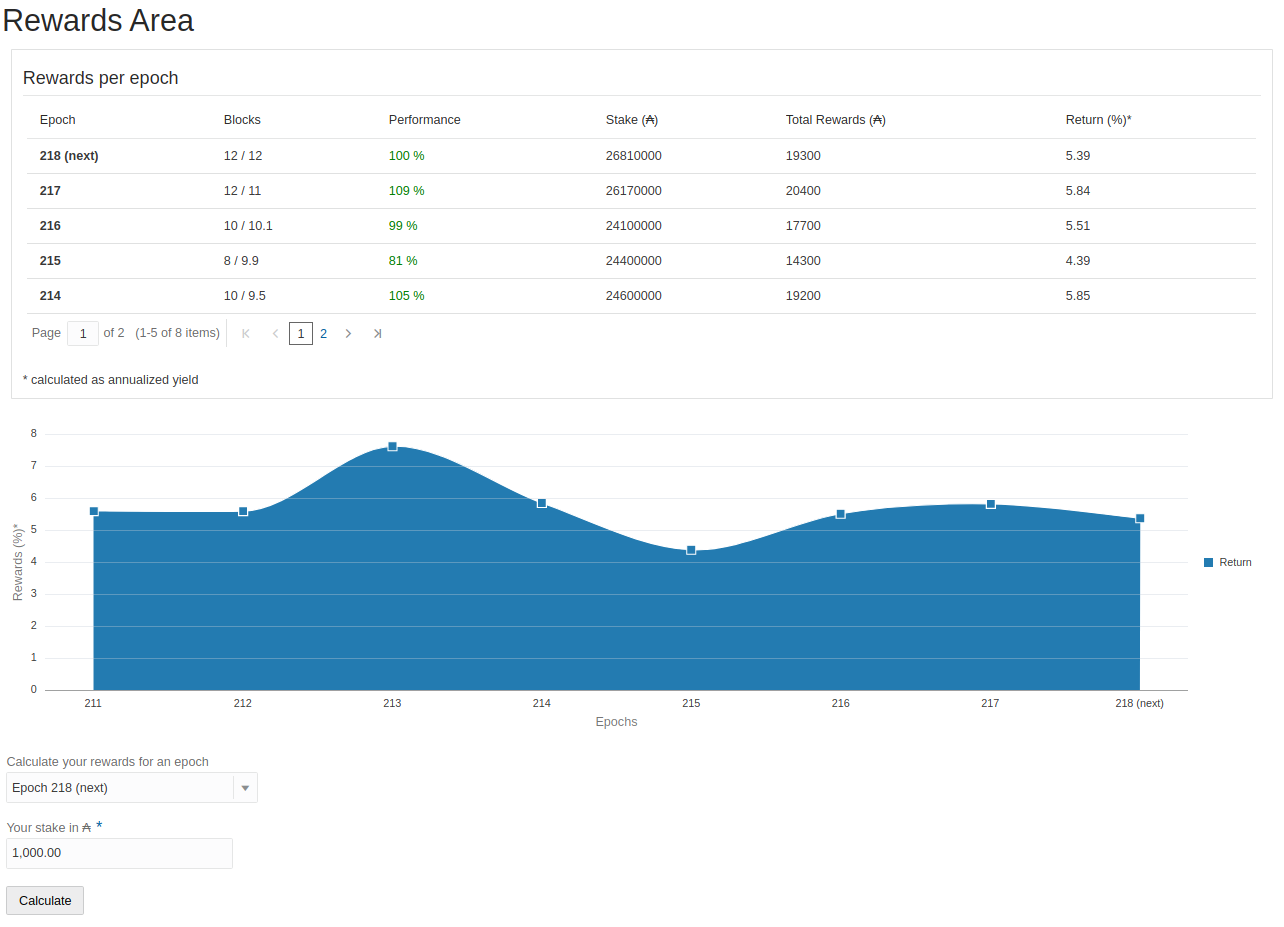
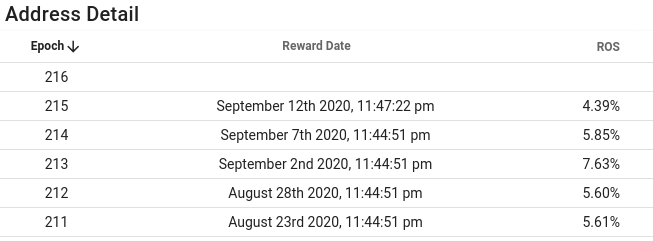
I added a new rewards page to my website to see the payouts of the pool across all epochs in detail. The epoch marked “next” will be the upcoming payout. Hope you enjoy it! 🥳

Summary of payouts across the first 5 epochs

The payout for the 5th epoch was the lowest so far for OCTAS: only 4.39 % yield annualized. This balances out one of the first epochs where we had 7.6 %.

The next payout will be very close to the average of ~5.5 %. Let's see how this epoch goes 🤞

This fluctuation happens to every pool sooner or later, and I prefer to be closer to the average each epoch instead of having one heavy one (e.g. 11 %) and the next close to 0 % to average this out 🙈

Thanks for staying with OCTAS 🥳

ROS and variable fees

A few hours ago the first rewards appeared and OCTAS has a ROS of 5.61 % (very close to my expectations).

Nevertheless I decided to lower my variable fee from 1.5 % to 0.9 % to stay competitive and rank higher with the start of epoch 214. I think this is also in your interest 🤑

Thanks for staying with me and welcome to Shelley! 🤓

Correction: rewards expectations

Today I figured out that the first calculation, based on a Medium article from PlanetStake, was incorrect and I want to correct this now.

The whole calculation is a lot more complicated and the number of blocks the pool mints is not what matters. The most important factor is performance: each block assigned to the pool has to be minted to reach 100 % pool performance.

Our pool minted 4/4 blocks and gets ~21,151 ₳ rewards for epoch 211. This number comes from a pool calculation spreadsheet (credit: SKY pool owner).

To know how much each delegator can expect at the beginning of epoch 213:

First the pool costs get subtracted: 21,151 ₳ − 340 ₳ (fixed) = 20,811 ₳ − 1.5 % (317 ₳) = 20,493 ₳ (~98 % base for distribution).

(your stake / 27,100,000 ₳) × 20,494 ₳ = your rewards for this epoch

This is equivalent to ~5.5 % yield annualized. I'm sorry for the confusion!

First epoch with block production

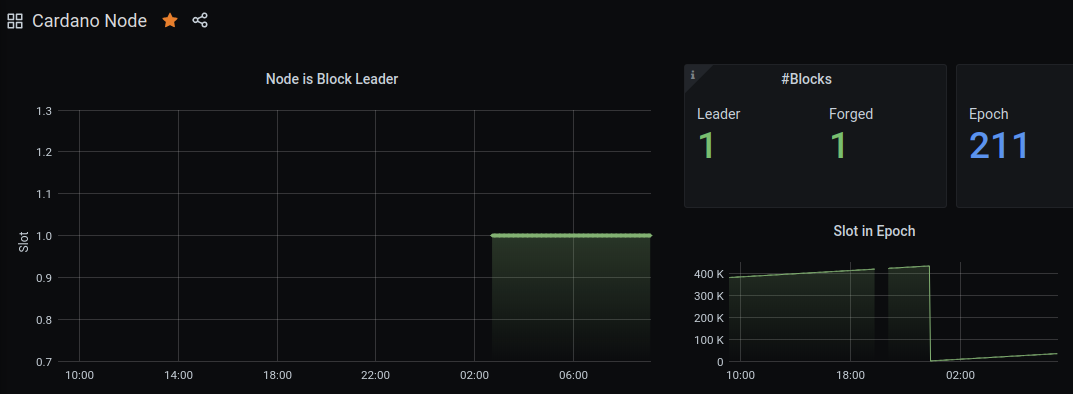
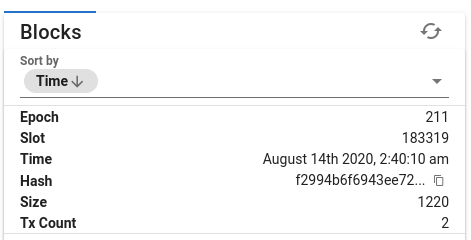
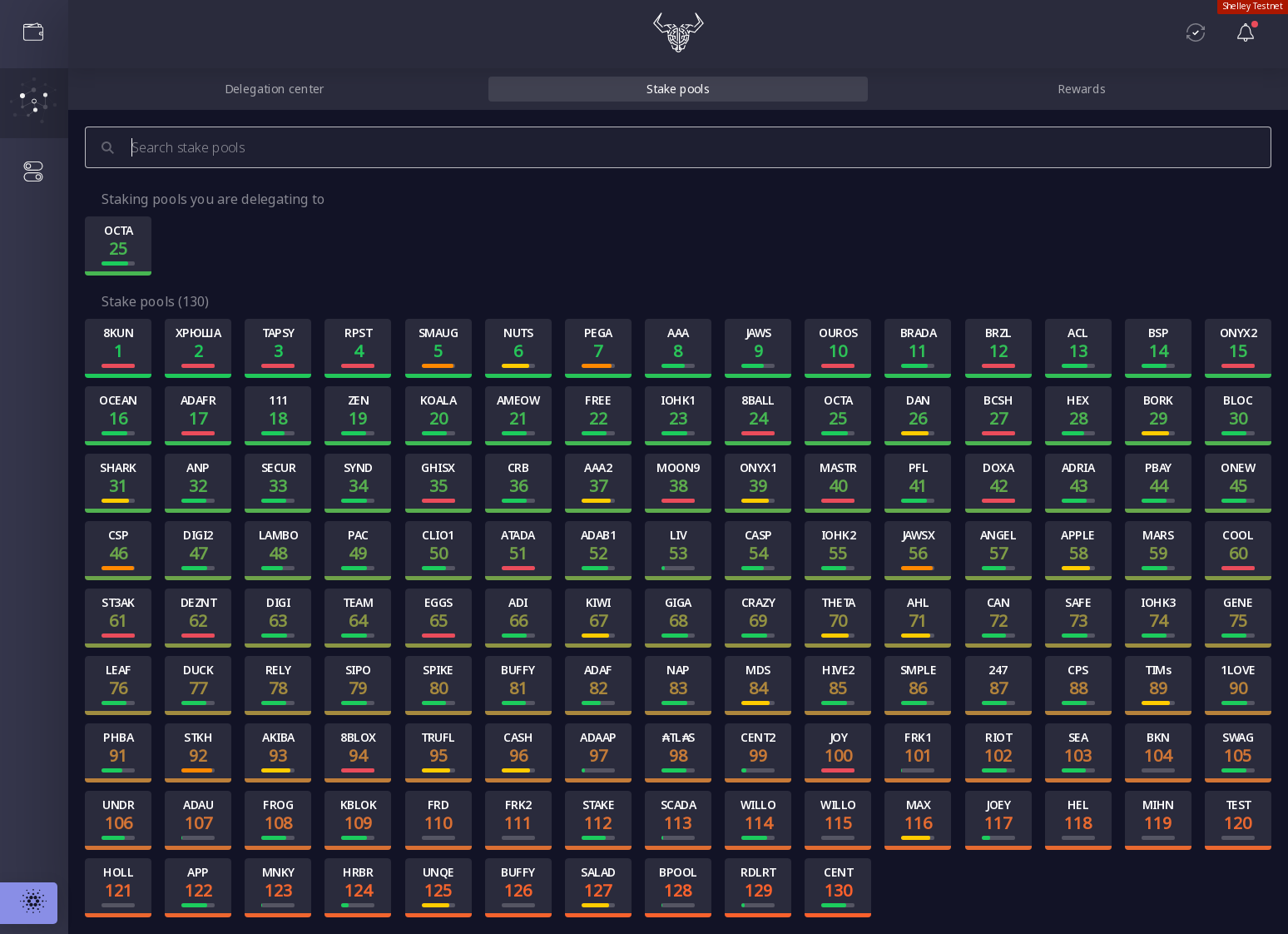
Last night the first epoch with block production passed and we made our first four blocks!

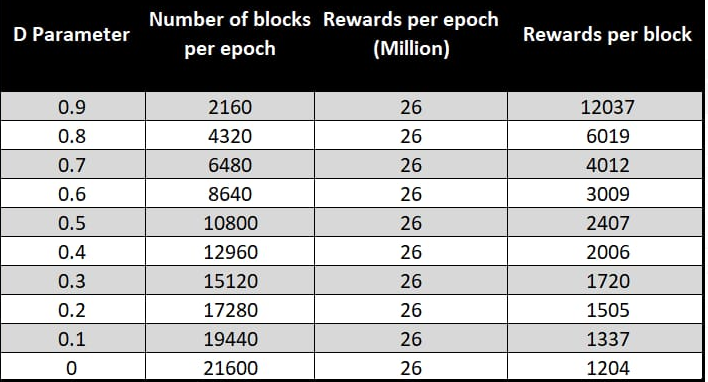
In epoch 211, 2,160 blocks in total were made by the community, which matches the parameter d = 0.9 we used. This parameter means that 10 % of all blocks during the epoch are made by the community, and all rewards for the epoch are distributed to these 2,160 blocks. The total number of blocks in an epoch is 21,600; the other 90 % (19,440 blocks) are made by “legacy” nodes run by IOHK without any block rewards.

Each epoch has 26 M ₳ rewards in total to distribute to the community blocks, which leads to a block reward of 12,037 ₳ in this very first epoch. Our 4 blocks generated 48,148 ₳ block rewards (+ some minor fees).

First the pool costs get subtracted: 48,148 ₳ − 340 ₳ (fixed) = 47,808 ₳ − 1.5 % (717 ₳) = 47,101 ₳ (~98 % base for distribution).

(your stake / 27,100,000 ₳) × 47,101 ₳ = your rewards for this epoch

This is equivalent to 12.7 % yield annualized – a nice start! :-D

The new epoch 212 is based on d = 0.8, which means 20 % of the blocks are community based with rewards. This doubles the available blocks, so our pool can have 8–9 blocks. Because the block rewards are also cut in half, epoch rewards will stay similar. How many blocks are finally assigned is randomized, so you never know. Could be 11 blocks or only 6.

We will see and stay strong! I take care to mint each block we get assigned! :-)

We got our first block on mainnet!

Yesterday was a crazy day. Only three hours before the new epoch started, where pool operators are able to mint the first blocks, IOHK rolled back the newest release v1.18.1. They discovered a problem with block production at the last minute and all operators had to go back to v1.18.0 in a very short time window. I saw this immediately and switched all nodes back to be stable in the upcoming epoch.

The new epoch started and after about 3 hours we got our first block :-) As soon as v1.18.2 appears I will switch over, because v1.18.1 had optimizations (next to the bug) which are not available in the older version.

The first rewards will be paid out on 23 August at 23:44 CET.

Thanks for having you on board! Let's enjoy the journey together. :-)

Telegram group

I opened a Telegram group to discuss open questions and offer statistics of the pool later in the game: Octa's Telegram group

Rewards calculation transparency

A short explanation of how rewards for delegators are calculated:

pool rewards − fixed pool fee − percentage pool fee = rewards for delegators

  1. Based on the total stake of the pool, it gets blocks it has the possibility to create. The pool collects rewards for each block it really made.
  2. After each epoch (5 days), the sum of all block rewards is the base. Let's assume 5,000 ₳. First the fixed fee is subtracted (5,000 ₳ − 340 ₳ = 4,660 ₳), then the variable fee of 1.5 % (4,660 ₳ − 69.9 ₳ = 4,590.1 ₳).
  3. This is spread across all delegators by their share of stake. If you delegate 100,000 ₳ and the pool has 10,000,000 ₳, you get 1 %: 45.901 ₳ per epoch, paid at the beginning of the next epoch.

In the end, bigger pools with more stake get more blocks, but spread the rewards across more delegators, so this is not necessarily more rewards per delegator. It's a balancing act until the saturation point is reached. With k = 150, saturation means 0.66 % of all staked ADA in one pool. Beyond that point the pool doesn't earn more, and each delegator gets less percentage-wise.

Mainnet! The very first registered pool

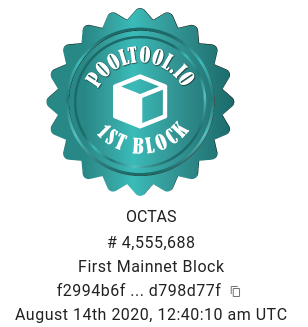
We are live and one of the first – no, even better: THE FIRST!

Charles Hoskinson mentioned my pool as the first on the Shelley chain. Very nice and an honor:

Upcoming Shelley mainnet launch (testnet MC4)

It is getting serious now! I tried to test as much as possible to get a routine with new networks.

I thought a lot about how high to set the pool fee percentage. A fixed minimum fee of 340 ADA per epoch is hardcoded, so I will stay with this value. In the long run the percentage should keep the pool in a positive cash flow and I don't want to increase it later. I will start with 1.5 % and maybe lower it to 1.0 %. With 1.5 % and my pledge of 450K ADA I should be competitive.

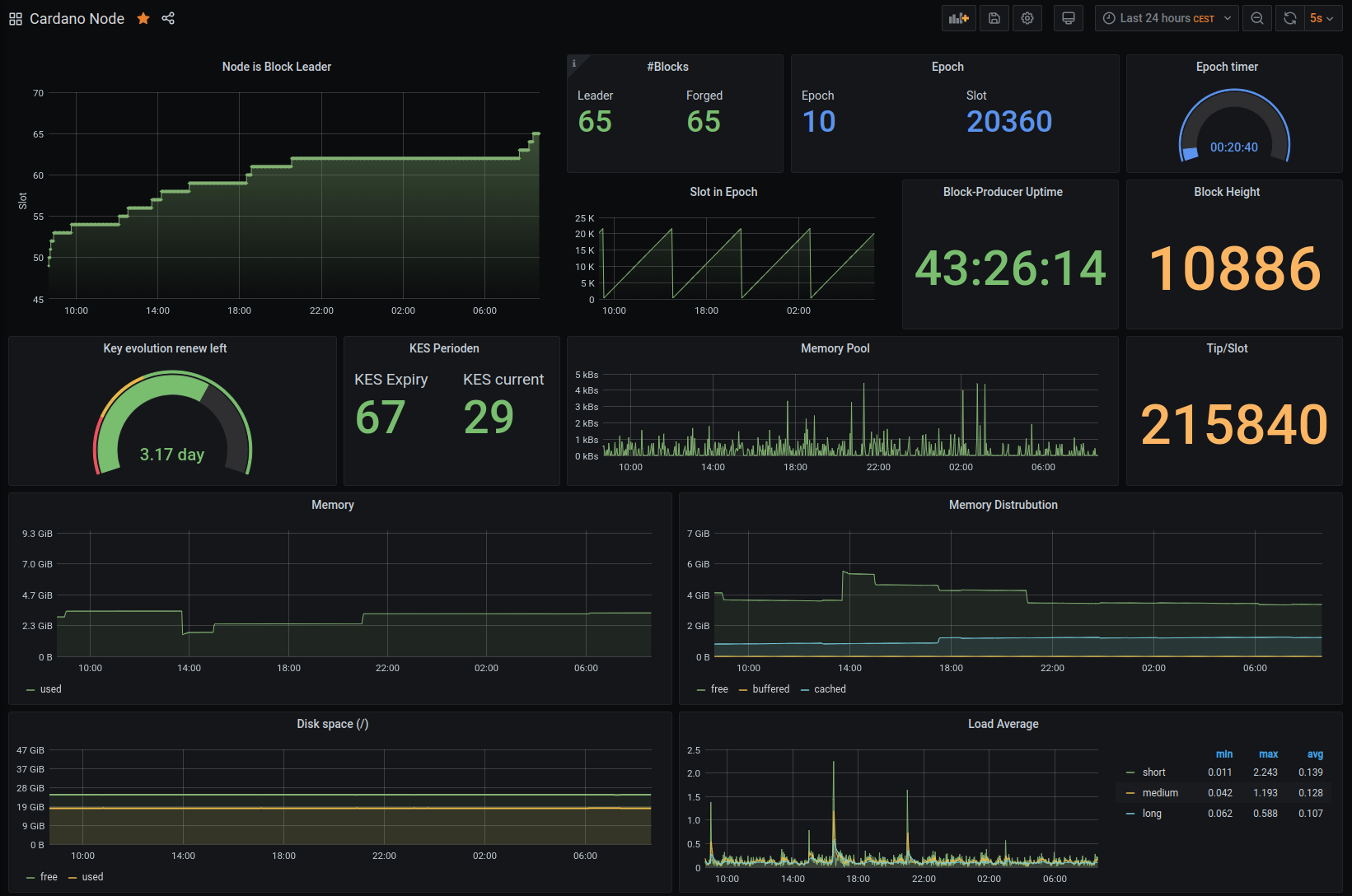
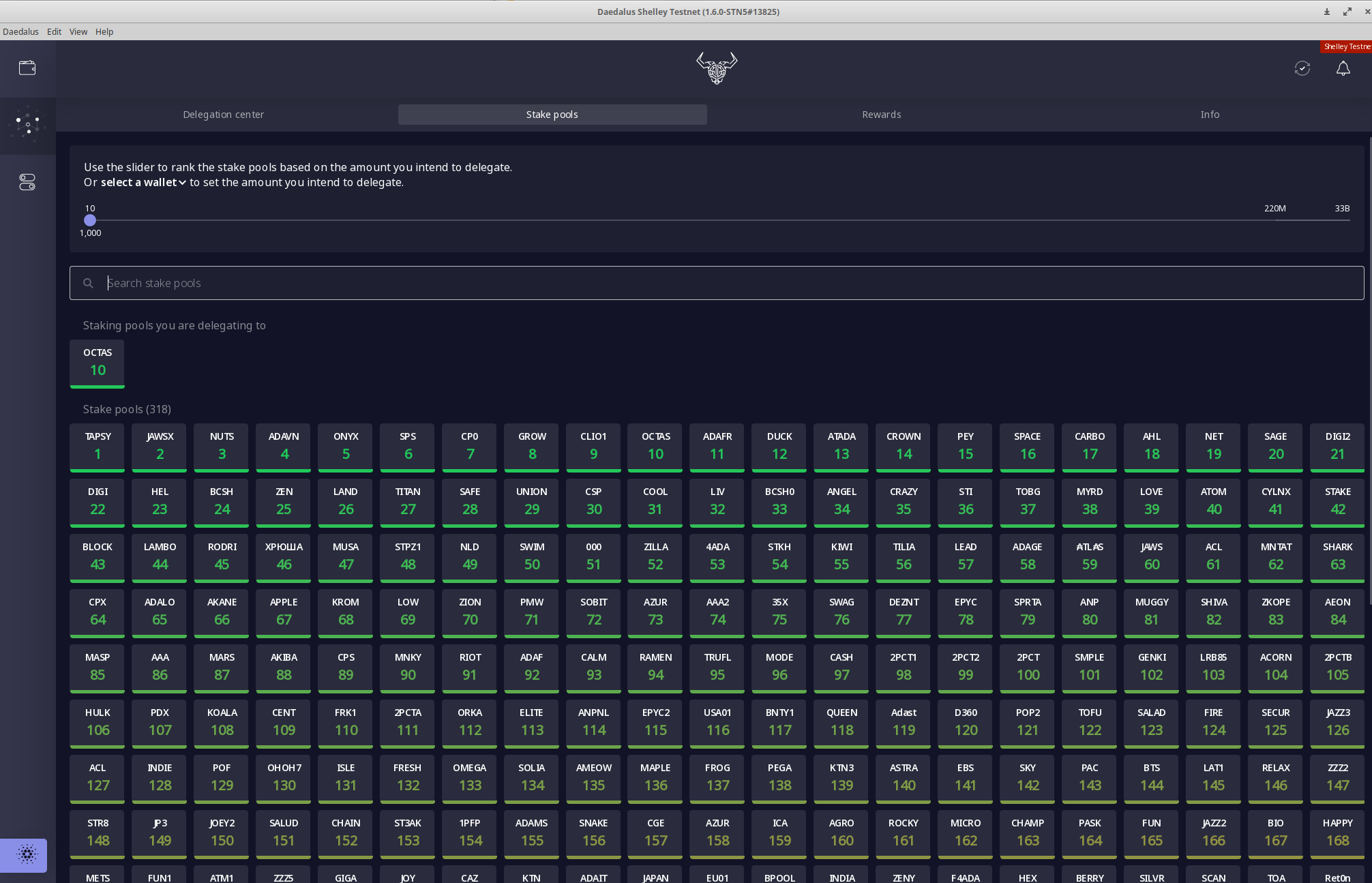
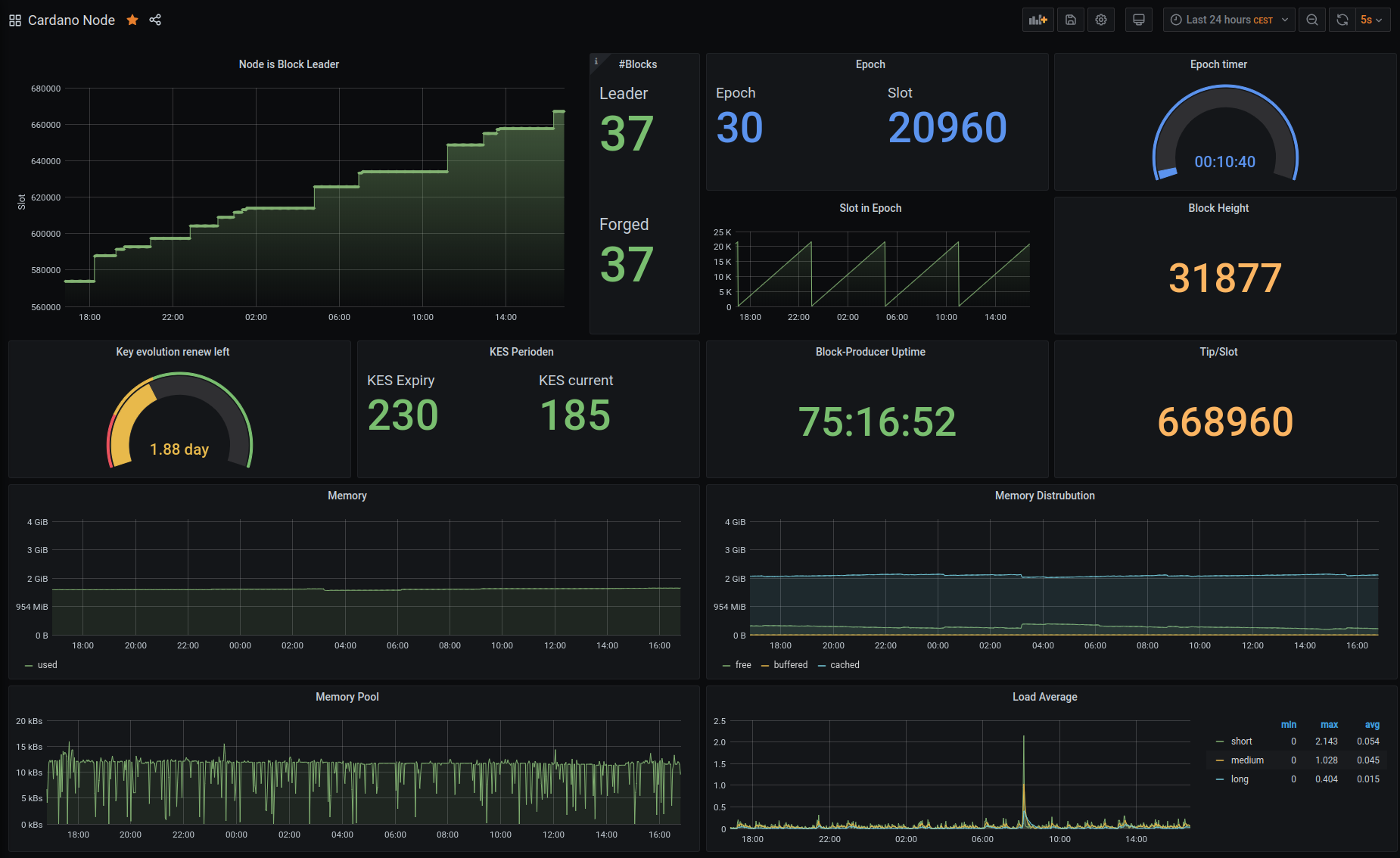
Right now the last testnet, “Mainnet Candidate 4”, is running and I'm positioned quite well: already 65 blocks and my metrics dashboard is running smoothly. I also got a verified sign in PoolTool and the Pegasus app.

Shelley testnet 1.14.2

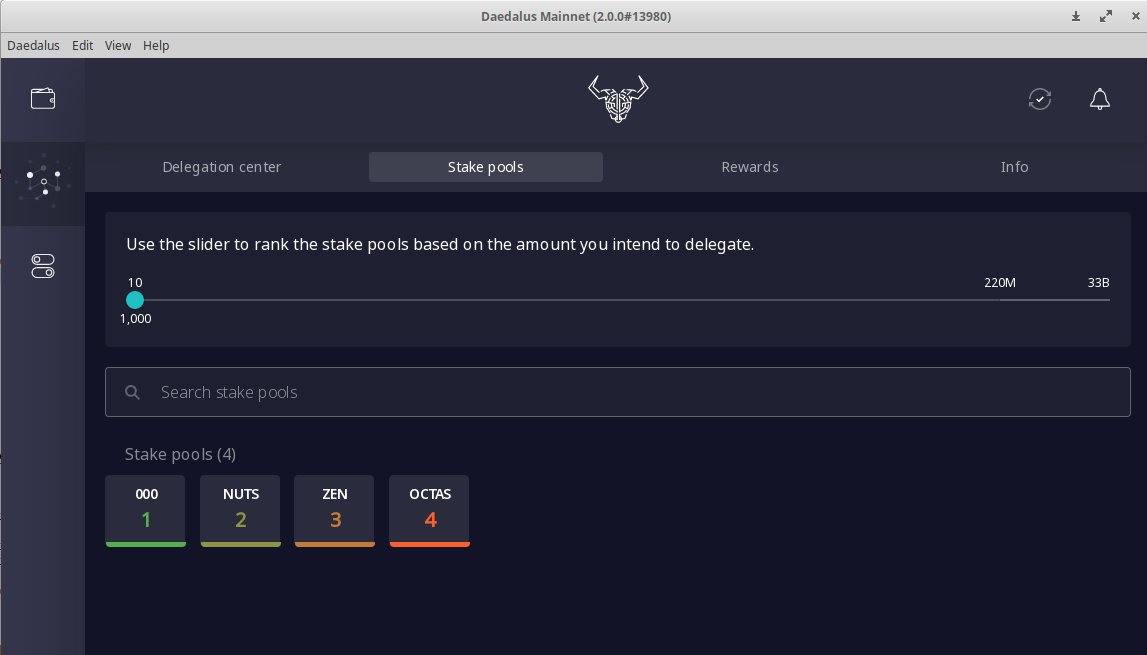
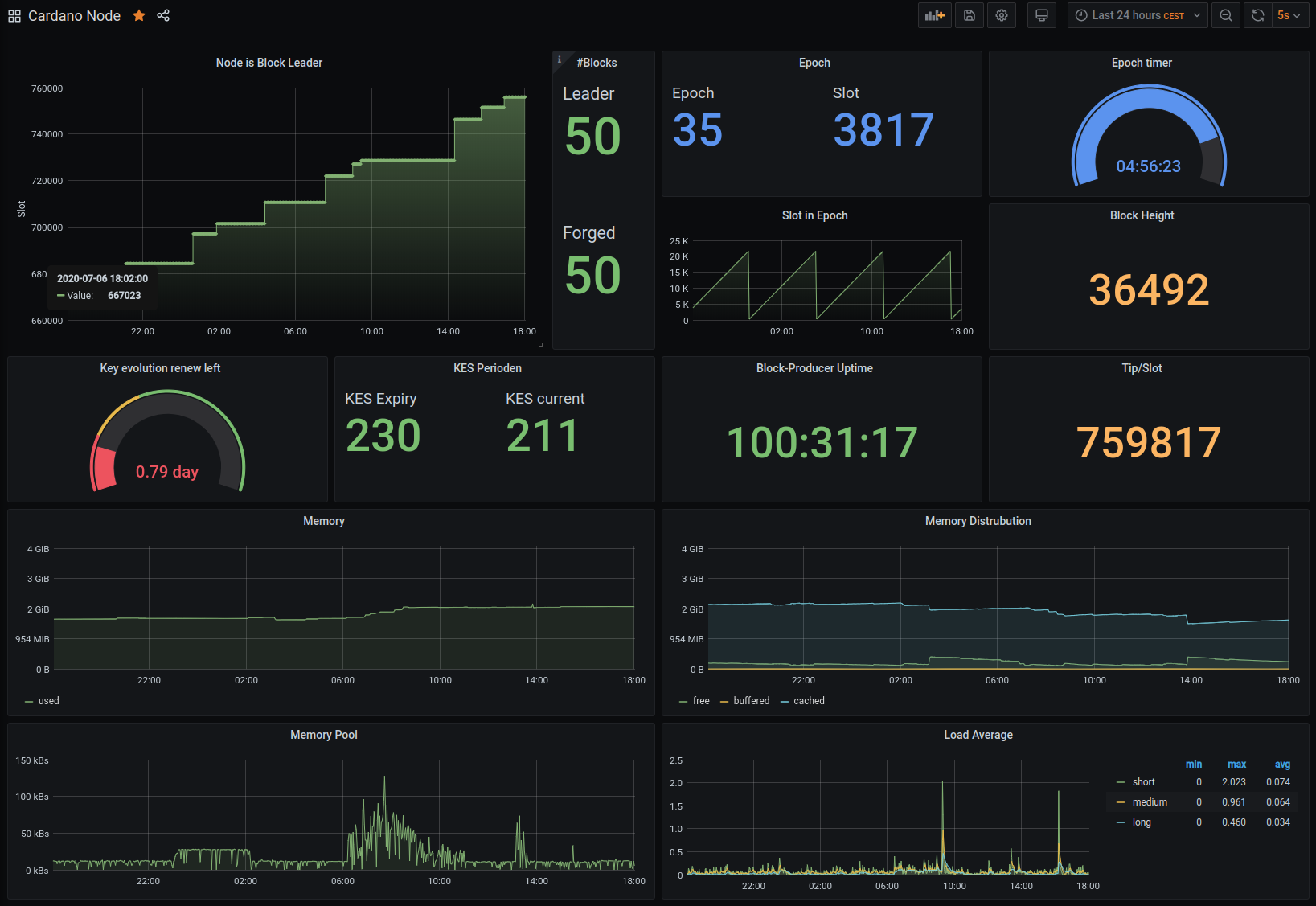
My node has been running for 100 hours and produced a solid 50 blocks with 100 % performance since the last restart. Looks perfect – I would say: prepared for mainnet! We are also visible in the new Daedalus test wallet, so registration was fine too.

Shelley testnet 1.14.2 preparations

Currently I'm working on a stable Haskell node for the upcoming mainnet.

Jormungandr 0.8.8

All problems solved and running like a charm now :-)

Jormungandr 0.8.7

I still have problems with bootstrapping in version 0.8.7. It seems that peers go into quarantine too fast, so no peers are left at startup. Because 0.8.6 runs fine I stay with it until the next version.

2019

Jormungandr 0.8.5

Switched to the newest stable version 0.8.5. It is stable enough, and my watchdog script keeps it running in case of a fork chain!

Recent problems

I finally figured out why I missed a lot of blocks, and my node is stable now! For stability reasons I stay with version 0.8.4 of Jormungandr even though 0.8.5 is already available.

Pool is online and registered

The idea is to give the rewards back to the people and take only the lowest pool percentage possible to cover costs. That's why we start with only 2 % and try to go even lower in future!

Maintenance or node updates will be published here so you can plan around possible downtimes.

Regards, Octa